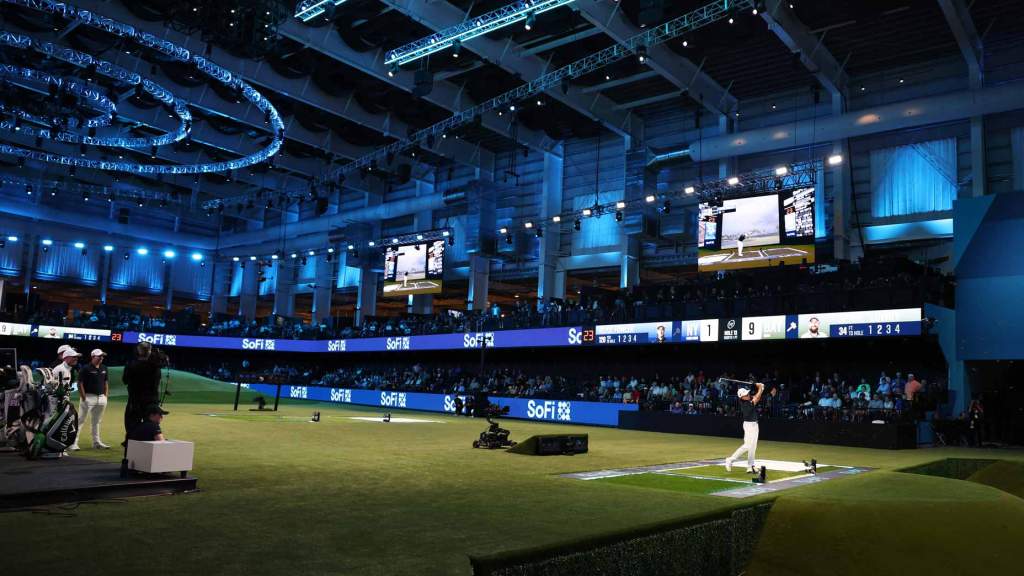
An Irishman, an Ozzy, and a Japanese man walk into a golf simulator. It’s not a dodgy and outdated one-liner, it’s the brand new ‘Boston Common Golf’ team at Tomorrow’s Golf League (TGL). If you’re wondering what any of those players (Rory McIlroy, Adam Scott, and Hideki Matsuyama) have to do with Boston, your guess is as good as mine. Sure, not every sports team is made up by a roster of local players, but most good ones are founded on a local history and identity. The TGL has arrived as the PGA’s response to LIV, revamping golf for the younger generation with its high-tech simulators, fast-paced play, and fantasy virtual golf worlds. But behind these flashy innovations is the same failure to capture the magic of team sport which has characterised LIV for the past three years.
Make no mistake, LIV is plagued with a host of problems which stretch far beyond its team format. Despite shelling out hundreds of millions of dollars to some of the best players in the world, LIV barely secures a tenth of the PGA’s viewing figures. The tour is haunted by an inescapable sense of low stakes as players take their payday before even stepping foot on the course. But accompanying these failures is the tour’s half-hearted attempt to convert golf into a team sport. The TGL now follows in that trend and while it might’ve promised to improve it, the early signs are lacking.
Golf stands in a unique position as a solo sport which has proven to adapt well to a team format, with the Ryder Cup remaining the biggest event in the golfing world. Every second year, the best players from the US and Europe gather together to compete in a showcase of sporting excellence defined by passion and pride. Molinari and Fleetwood become Moliwood and two plus two equals five. European fans go wild and American fans even muster a chant of ‘USA’ or ‘Barbeque’ once in a while. Certainly, part of this success stems from the excitement of seeing players compete with, rather than against, one another on a special occasion. But an equal part of its success owes to the fact that fans share an identity with their team. No one turned up to Marco Simone contemplating who they would support, in the same way that no fan arrives at the Old Firm with a half and half scarf. Every fan is inherently represented, they belong to one side or the other and have no choice in the matter. The popularity of the Ryder Cup must, to some degree, explain the recent trend towards team formatting in golf, yet both LIV and the TGL seem to have forgotten that vital factor of identity and representation.
In LIV, the identity of the team rests on the identity of the individual. Bryson fans support Crushers, Mickelson fans support HyFlyers, and Rahm fans – if they exist – support Legion XIII. In essence, those teams aren’t teams at all, they’re extensions of each captain’s personal branding. Of course, artificially generating any die-hard fanbase is a difficult task. No golf team dreamed up three years ago in Saudi Arabia is going to have the same kind of fans as a centuries old football team supported through generations. But that doesn’t mean that the teams have to forgo any form of identity at all.
What the TGL promised was something new and more authentic with its regional teams. But in practice the links between each team and the area it represents are nominal at best. Of the eight players on the two Californian teams, only two are natives of the state. You can find more Californians playing on the New York team, the Atlanta team, and the Jupiter team than you can on ‘The Bay Golf Club’. That’s not to mention the lack of representation for anywhere outside of the US, in spite of the ten non-American players which make up nearly half of the roster. So, it’s hard to imagine any fan feeling a deep sense of identity and belonging with a TGL team – even if they did happen to come from one of the six cities represented. As with LIV, each side is nothing more than a collection of individual personalities.
Far from revolutionising golf and capturing the imagination of a younger generation, the emergence of LIV and the TGL has been characterised by flagrant disregard for the fundamentals of sport fandom. A love affair with a sports team has to be woven into your identity. It’s the team your dad grew up watching, the team that represents own hometown, or the team you share a passport with on international days. It is not Crushers and it is certainly not the disparate members of the Boston Common Golf Club. Only as we watch the inaugural season of the TGL playout will we see the value of the event’s unique and innovative format. But the team setup doesn’t look to inspire passion among supporters and I won’t be holding my breath for fights in the car parks as ultras flood out the warehouse.
Image courtesy of Golf Magazine
 The Thin of It
Leave a comment