In 1990, at the dawn of the internet, American attorney Mike Godwin made an astute prediction about the nature of online discourse. Now known as Godwin’s Law, his theory suggested that the longer an online debate continues, the more likely it becomes for one party to compare the other to the Nazis. In 2017, as political debate swung towards contentious polarities and the truth of this adage became increasingly evident, Time Magazine interviewed Godwin as a prophet for the modern age. Though Godwin might’ve been one of the first to relate this idea to the internet, the fundamental principle he espoused is just a simple fact of the modern world. The scale and horror of Nazi violence has led the name to become a byword for evil – an example that your opponent and audience will always be as familiar with as they are shocked by. It’s for that very reason that Nazi analogies are not confined to just chatrooms in the ‘90s or Twitter culture wars today, but also pervade our most beloved works of cinema – and have done for decades. We saw Nazis in space with Star Wars, Nazis in the Pridelands with a Hitlerian Scar in The Lion King (1994), and now we have seen Nazis in Oz with Wicked proving an undeniable cultural and commercial phenomenon. But just as these analogies are notoriously ill-judged and ineffective in debate, they prove equally unhelpful on screen.
More famous and influential than any other Nazi allegory, the success of George Lucas’s depiction of ‘the Empire’ stems neither from its historical precision nor its subtlety. The omnipresent imperial crest resembling a space-age Swastika, the monolithic architecture exuding total power, and, of course, actual Stormtroopers, create a clear sense of who our villains represent. Other choices seem more meaningful. In The Force Awakens, we see a rally for the First Order – an unimaginative revamp of the Empire – plainly resembling Nuremberg. More than just a historical reference though, this is a visual quotation of Leni Riefenstahl’s Triumph of the Will, perhaps the most famous work of Nazi cinema, which glorified the orderly masses at the Nuremberg Rallies and deified their leader. Disney animators took similar inspiration from the Riefenstahl film for staging Scar’s threatening musical number ‘Be Prepared’ in The Lion King. In some regard these visual tropes indicate a sharp understanding of culture in Nazi Germany, playing on the fact that fascism places great importance on aesthetics and thus translates well to film. Thoughtful as these details may be, they cannot conceal the glaring omissions in Star Wars’ allegorical portrayal of Nazism—most notably, the absence of any clear parallel to the racism or antisemitism that lay at the heart of the Nazi ideology. In Star Wars, the Empire’s enemies are the rebels who oppose their tyranny, but no real allusions are made to the marginalisation or persecution of one group. In effect, the entire franchise is conceived with Nazi-style arch-villains, yet any group to represent the Nazis’ greatest victims is entirely omitted.
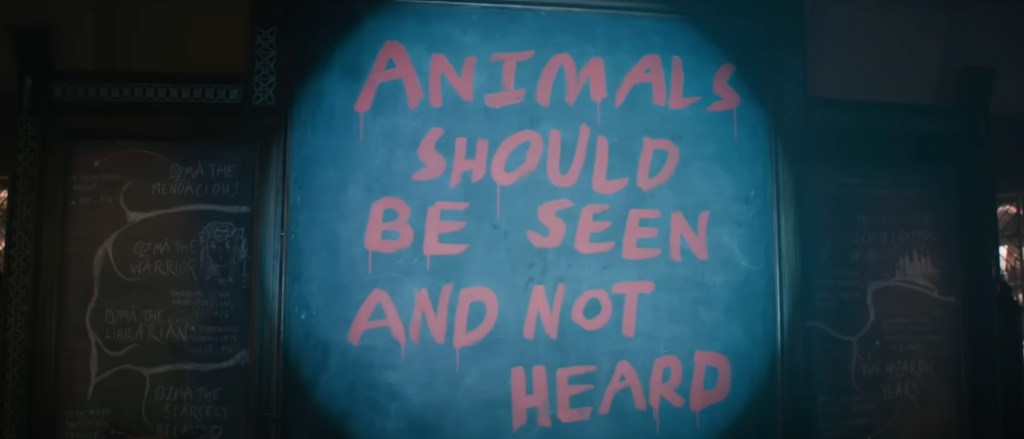
In contrast, Wicked centres victims at the heart of its allegory, which only constitutes a sub-plot of the film’s wider narrative. Cynthia Erivo’s Elphaba, an outcast in her own right, dedicates herself to the protection of animals, whose status has become increasingly denigrated by the Wizard of Oz. For all its merits, Wicked’s allusions to Nazism are hardly well-cloaked either. In one of the most heavy-handed allegorical references in cinematic history, it’s explained that the persecution of animals in Oz stemmed from their scapegoating in ‘The Great Drought’. Other references are clearly directed at the big ideas of Nazism if not so explicit in their mirroring. The Nazi idea of a ‘people’s community’ characterised by opposition to outsiders is alluded to as the Wizard suggests “the best way to bring people together is to give them a real good enemy”. The blue monkey guards in the Emerald City are mutilated and forcibly turned into a kind of Ozian Gestapo. Indeed, it seems to have gone astonishingly under-acknowledged that through all its singing, dancing, and comedy, Wicked – at least in part – constitutes a representation of 1930s Germany. Some judgement on Wicked may be withheld on account of it only truly being half a film. Regardless, it should go without saying that, in the subplot of a whimsical, comical, and heartfelt musical, the Nazis have no place. Plain lazy writing becomes reckless and insensitive when such real and consequential historical groups are shoehorned into contexts in which they simply do not belong.
None of this is to suggest that the writers and creatives involved with Star Wars or Wicked were terribly offensive, grossly negligent, or even particularly bad at their jobs – both are huge cultural success stories and for good reason. But they do indicate a paradoxical cultural desensitisation to Nazism. Nazi analogies are so widespread because the Nazis are seen as the most awful, most shocking embodiment of evil imaginable. Yet their ubiquity in cinematic, literary, and rhetorical analogy has changed the way we interact with Nazism and threatens to change the way we even think about it, as constant inappropriate comparison urges us to desensitise. No doubt, these filmmakers are well-intentioned, for the most part seeking to warn against fascism and its insidious re-emergence. But for the sake of both creativity and sensitivity, it’s time to retire the Nazi allegory on screen.
Image courtesy of Universal Pictures
 The Thin of It
Leave a comment